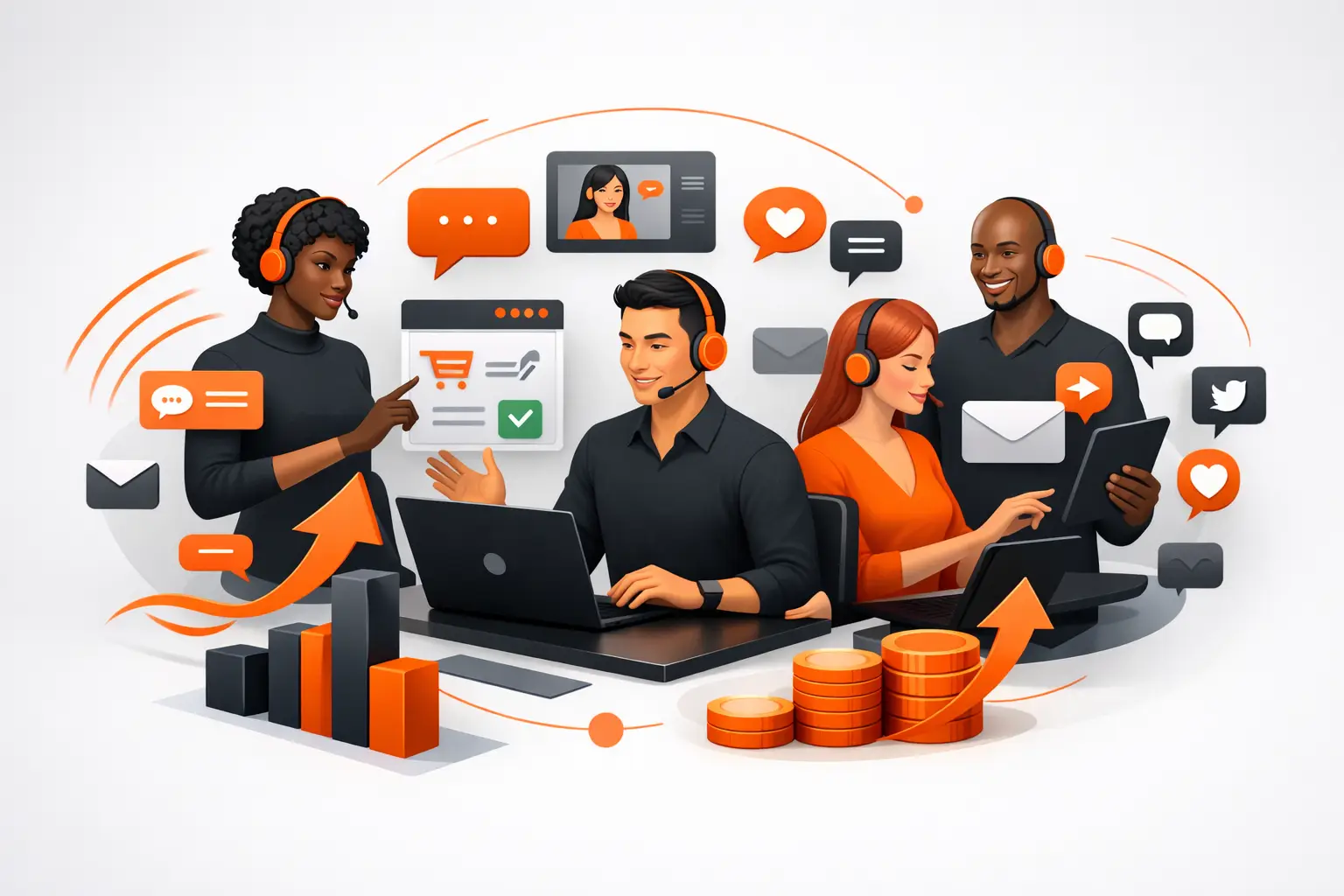
A shopper leaves a product page after asking whether an item will arrive before Friday. A caller hangs up during the lunch rush. A prospective tenant sends a message at 10:47 p.m. asking about availability. In a reactive operation, each of those moments becomes a ticket waiting for someone to notice it. With proactive AI customer engagement, they become opportunities for an employee who is already on duty.
The shift matters because customer demand does not arrive in clean batches during business hours. It comes through every door: phone, web chat, SMS, email, social messages, WhatsApp, Slack, and Microsoft Teams. Businesses that wait for customers to chase a reply lose speed, context, and often the sale.
What Proactive AI Customer Engagement Actually Means
Proactive engagement is not blasting promotions or dropping automated messages into every inbox. It is the disciplined use of customer signals to start the right conversation, at the right moment, with a useful next step.
An AI Digital Employee can recognize that a caller has contacted your business before, see that a web visitor abandoned a booking flow, or identify an unanswered email tied to an open order. It can then respond using the same persona and current business knowledge across channels. The goal is not more messages. The goal is fewer missed moments.
For a home-services company, that may mean texting a customer whose call disconnected before an appointment was booked. For a Shopify merchant, it may mean answering a delivery question in chat, then following up when the customer leaves a cart containing a high-margin product. For a property manager, it may mean responding to an after-hours inquiry in the prospect's preferred language and offering real calendar availability.
The difference is operational. Reactive systems wait for work. Proactive AI identifies work, acts within guardrails, and brings in your team only when judgment, approval, or a sensitive conversation is required.
Where Proactive AI Engagement Produces Revenue
The best opportunities are usually hiding in workflows that feel ordinary. They are the conversations staff handles repeatedly, inconsistently, or too late because the team is busy serving the people already in front of them.
Recover demand before it goes cold
Lead speed is a revenue lever. A prospect who asks for a price, service area, or appointment time is showing intent right now. If the answer arrives hours later, that prospect may have already contacted three competitors.
A proactive AI Sales Rep can respond immediately, ask qualifying questions based on BANT criteria, confirm location or product fit, and book the next available appointment. If the lead has budget authority and a near-term need, the AI can route the full conversation record to the right salesperson rather than making them start from zero.
That approach also works after a missed call. Instead of sending a generic "we missed you" message, the AI can identify the caller, reference the relevant service category when known, and offer a specific next action. A missed call can become a booked estimate before a staff member is free.
Keep carts, bookings, and applications moving
Abandoned carts are not always a price problem. Many shoppers leave because they are uncertain about fit, inventory, delivery timing, returns, or installation. An AI Digital Employee can use browsing and conversation context to answer the obstacle directly, recommend a compatible item, or surface an option that meets the customer's deadline.
The same pattern applies to appointment-based businesses. If someone begins a booking but stops before confirmation, the AI can offer alternate times, answer preparation questions, and send a reminder through the channel the customer already used. The workflow should feel like service, not pursuit.
Prevent avoidable support contacts
Proactive support is often the fastest way to reduce incoming volume without reducing service. Order confirmations, fulfillment updates, appointment reminders, pre-arrival instructions, and delay notices answer the questions customers are about to ask.
Context determines whether these messages help or annoy. A customer waiting for a shipment needs a clear status and a path to help. A customer whose order is already delivered does not need another delivery update. Good AI engagement reads the operational event, checks the customer record, and acts with restraint.
Build an AI Employee, Not a Campaign Machine
The strongest deployments begin with a defined job. "Engage customers proactively" is too broad to manage. "Recover incomplete service bookings," "qualify after-hours leads," or "reduce where-is-my-order contacts" gives the AI a clear purpose, a measurable outcome, and boundaries for action.
Quincer approaches this as hiring AI Digital Employees rather than adding another disconnected bot. An AI Receptionist can answer and route calls. An Appointment Agent can book, reschedule, and remind. A Support Agent can resolve routine order and account questions. A Lead Qualifier can collect decision criteria and escalate a sales-ready opportunity.
Each role needs access to the information required to do its job: business policies, inventory or service coverage, calendars, CRM records, order status, and location details. It also needs permission rules. The AI may be able to book an appointment but not approve a refund over a set amount. It may recommend a product but not make claims your business cannot support.
Persistent conversation memory is what keeps this from feeling fragmented. A customer should not have to repeat an issue after moving from web chat to SMS, or from a missed phone call to email. One persona, one thread of context, and a clear record in the CRM make proactive outreach more relevant and staff follow-up faster.
Set Guardrails Before You Scale Outreach
Proactive does not mean intrusive. The wrong trigger can turn helpful service into noise, especially in regulated, health-related, financial, or high-consideration purchases. Start with high-confidence events where the customer has clearly requested help or begun a transaction.
Use a practical escalation model. The AI should handle routine questions and approved actions, ask for clarification when information is missing, and transfer conversations involving complaints, billing disputes, safety, privacy, legal issues, or unusually valuable opportunities. Your team is only pinged when it matters.
Review conversation transcripts and reasoning traces during the early rollout. Look for messages that sound too persistent, answers that rely on stale knowledge, or handoffs that happen too late. The right balance depends on your industry, customer expectations, and the cost of a mistake. A luxury hospitality brand may use fewer, more personalized follow-ups. A high-volume ecommerce operation may prioritize fast, concise updates at scale.
Start With One Workflow That Has a Clear Finish Line
You do not need to automate every channel on day one. Choose one customer journey with enough volume to matter and a clear action at the end: an appointment booked, a lead qualified, a cart recovered, an order issue resolved, or a ticket routed.
Map the current workflow honestly. Identify the trigger, the data the AI needs, the messages it can send, the actions it can take, and the point where a human must step in. Connect the calendar, CRM, phone system, commerce platform, or help desk that holds the source of truth. If the AI cannot see real availability or current order status, it should not pretend that it can.
Then test real scenarios before turning on broad outreach. Try a repeat caller, an out-of-stock item, an incomplete address, a Spanish-language inquiry, a customer who wants a human immediately, and a lead that contacts multiple locations. These are not edge cases. They are normal operating conditions.
Once the workflow is live, expand by role or channel. A business might begin with after-hours phone coverage, add web chat for lead capture, then use SMS for booking reminders and follow-up. The same AI persona should carry context forward, while each channel follows its own consent and communication rules.
Measure the Business Result, Not the Message Volume
More outbound messages are not a win by themselves. Track whether proactive AI changes the economics of customer engagement. The most useful measures are:
- Lead response time and contact rate after a missed call or form submission
- Qualification rate, appointment set rate, and appointment show rate
- Cart recovery, assisted conversion, and revenue influenced by AI conversations
- Support resolution rate, repeat-contact rate, and staff hours removed from routine work
Review results by channel, location, product line, and customer segment. A workflow may perform well on SMS but poorly on email, or generate appointments in one region while producing low-quality leads in another. That is not failure. It is direction for tuning triggers, copy, qualification questions, and handoff rules.
The practical test is simple: can the AI take a customer from uncertainty to a useful outcome without making them wait or making your staff clean up the conversation later? When it can, proactive engagement stops being a marketing experiment. It becomes dependable coverage for the demand your business already earns.
Put your first AI employee on the conversations that currently disappear between busy shifts, closed hours, and overloaded inboxes. Those customers are already raising their hands. They should not have to raise them twice.